
Last updated September 22, 2026
Non-destructive entry first, always - and we re-key Schlage, Kwikset, and Baldwin locks on the spot while you watch
You get a price before we start. It does not change when we arrive. No surprises.
How to Hire a Locksmith Contractor in Los Angeles: A Step-by-Step Guide
California law requires locksmiths performing work over $500 to hold a C-28 license from the Contractors State License Board - but fewer than half of the companies that appear on the first page of Los Angeles search results can produce one on request. We’ve been called to fix botched installations in Silver Lake where the hardware was non-compliant with fire code, and to rekey homes in Venice where the previous “locksmith” had no insurance and left the customer with no key records. This guide puts the verification steps before the phone call, so you never negotiate with someone who shouldn’t be working on your property. For more guides & resources, visit our blog.
Quick Answer
To hire a legitimate locksmith contractor in Los Angeles, verify their CSLB C-28 license online, request a written scope with itemized pricing before any technician is dispatched, confirm their Certificate of Liability Insurance specifically covers locksmith operations, and demand post-job documentation including a photo record and key inventory. These four checks take under ten minutes and eliminate most bait-and-switch operators, unlicensed contractors, and uninsured technicians from consideration.
Table of Contents

- Step 1: Verify the C-28 License Through CSLB
- Step 2: Request a Written Scope Before Dispatch
- Step 3: Confirm Insurance Covers Locksmith Work
- Step 4: Lock in a Contractually Firm Quote
- Step 5: Demand Post-Job Documentation
- Red Flags That Should End the Conversation
- Los Angeles-Specific Considerations
- Common Mistakes to Avoid
- When to Call a Professional
- Frequently Asked Questions
Step 1: Verify the C-28 License Through CSLB
Most consumers check one license. You need to check two: the company license and the individual technician’s license status.
The C-28 classification - Lock and Security Equipment - is a specialty contractor license issued by California’s Contractors State License Board. Any locksmith job in Los Angeles exceeding $500 in labor and materials requires it. Operating without it is a misdemeanor, and work performed by an unlicensed contractor voids your homeowner’s insurance coverage for related damage in most policies we’ve reviewed.
How to Run the Check
- Go to checkthelicensefirst.com (the CSLB’s official lookup).
- Search by business name first. Note the license number, status (Active, Suspended, Cancelled), and the “Personnel” section listing the qualifying individual.
- Search by individual technician name if someone specific is being sent to your property. In California, the qualifying individual on the company license and the technician doing the work are often different people. The company can be licensed while the employee is not individually registered.
- Check disciplinary actions in the license detail. A suspended license is common after complaints for abandonment or financial misconduct.
What you’re looking for: Active status, current bond, and no pending disciplinary actions. If the dispatcher cannot provide a license number within thirty seconds, that is not a detail they are forgetting. That is a company operating outside the law.
We’ve seen unlicensed operators in the San Fernando Valley advertise “locksmith services” while holding only a general B license, which does not permit security hardware installation. The C-28 exists because lock work intersects with fire egress codes, ADA compliance, and insurance underwriting. A general contractor’s license does not cover it.
Step 2: Request a Written Scope Before Dispatch
A written scope of work is not an estimate. It is a binding document that defines what will be done, what hardware will be installed, and what the total price will be before anyone leaves for your address.
At Novak Lock & Security Los Angeles, every scope includes six line items minimum. You should demand the same from any contractor you consider:
- Labor description - specific operations (rekey, install, repair, bypass) with time estimates
- Hardware specification - manufacturer, model, finish, and grade (Grade 1, 2, or 3 for residential; ANSI/BHMA ratings)
- Key quantity and type - number of keys, whether they are standard, high-security, or restricted
- Service call fee - if any, stated separately from labor
- Total price - inclusive of tax, with no “plus materials” open ends
- Technician name and dispatch window - so you know who arrives and when
The scope should arrive by email or text, with a company header and a signature line. A text message saying “$150 to rekey” is not a scope. A verbal quote over the phone is not a scope. We’ve been called to jobs in Pasadena where the customer was quoted $89 on the phone and charged $340 at the door because “the lock was more complicated than described.” A written scope prevents this by defining the lock before the technician leaves the shop.
Ask specifically: “Will the technician be permitted to change this price after arrival?” If the answer is anything other than no, you are not receiving a firm quote. At Novak, Haven Standard Clause 1 states: the price on the phone is the price on the invoice. The technician carries no authority to modify it. This rule has been in place since 2002.
Step 3: Confirm Insurance Covers Locksmith Work
General liability insurance is not generic. A policy covering “general contracting” or “handyman services” does not automatically extend to lock bypass, safe work, or access control installation. You need to see a Certificate of Liability Insurance (COI) that lists locksmith operations specifically.
What a Valid COI Looks Like
The certificate should show:
- Named insured matching the company you’re hiring
- Policy type - Commercial General Liability, not personal or professional liability alone
- Operations covered - look for “locksmith services,” “security equipment installation,” or C-28 classification reference
- Policy limits - typically $1 million per occurrence, $2 million aggregate for residential; higher for commercial
- Effective and expiration dates - current, not expired
- Certificate holder - your name and address can be added at no cost if you request it
Request the COI by email before scheduling. A legitimate contractor generates these in minutes through their insurance portal. Stalling, offering to “bring it to the job,” or sending a screenshot of a policy declaration page instead of the ACORD 25 form are all locksmith warning signs we’ve documented for Los Angeles homeowners.
In Los Angeles, where many properties are multi-unit buildings or commercial spaces with master key systems, the stakes are higher. A technician without proper coverage who damages a fire-rated door during a lock installation can leave the property owner liable for code violation fines. We’ve replaced hardware in Downtown LA lofts where the previous installer’s work had to be redone entirely because their unlicensed status voided the building’s insurance for the claim.
Step 4: Lock in a Contractually Firm Quote

The locksmith trade in Los Angeles has a documented bait-and-switch problem. The pattern is consistent: a low verbal quote, a technician who arrives and claims “unexpected complications,” and a final bill 200-400% above the original figure. The customer pays under duress, often locked out or with security compromised, and has no written record to dispute.
A contractually firm quote has three characteristics:
- It is in writing - email, text with company header, or signed document, not verbal
- It specifies no-change language - “This price is guaranteed and may not be modified by the technician”
- It includes a scope limitation - “Price valid for described work only; additional work requires separate written authorization”
Ask directly: “If your technician finds something unexpected, what is the procedure?” The legitimate answer is: stop work, contact the office, and obtain your written approval before continuing. The illegitimate answer is some variation of “the technician will handle it on site.”
At Novak, the dispatcher quotes a firm price based on the lock description you provide. That price is entered into our system before the technician departs. The technician’s tablet displays it; the invoice prints it. There is no override function. This is not a policy we advertise; it is a technical constraint built into our dispatch software. Since 2002, we have not had a price changed at a customer’s door.
Be wary of pricing that seems designed to obscure. Common tactics in Los Angeles include:
- “Service call $19” - the technician then charges $180 for “labor” and $90 for “parts” on a simple rekey
- “Rekey starts at $25” - per cylinder, with a four-cylinder minimum, plus trip charge, plus key fees
- “We’ll assess on site” - no price commitment until arrival, when you’re already committed
Honest pricing for common Los Angeles locksmith services, based on what we quote in writing:
| Service | Typical Range | What’s Included |
|---|---|---|
| Residential rekey (per cylinder) | $25-$45 | Labor, 2 standard keys, written key record |
| Lock installation (standard deadbolt) | $120-$200 | Labor, Grade 2 hardware, 2 keys, photo record |
| Emergency lockout (residential) | $85-$150 | Service call, labor, no damage entry if possible |
| High-security cylinder install (Mul-T-Lock, etc.) | $280-$450 | Labor, cylinder, 3 keys, key registration |
| Master key system (per cylinder, commercial) | $45-$85 | Labor, pinning, key schedule, documentation |
These are ranges, not quotes. Your specific price is quoted in writing before dispatch, with no call-out surcharge added on arrival.
Step 5: Demand Post-Job Documentation
What you receive after the job is as important as what you agree to before it. Legitimate locksmiths in Los Angeles provide documentation that protects your warranty, your insurance, and your security.
The minimum documentation package should include:
- Itemized invoice - matching the pre-job scope, with any changes initialed by you
- Hardware documentation - model numbers, serial numbers, and grade ratings of installed locks
- Key record - quantity issued, key codes (for non-restricted systems), and registration details for high-security keys
- Photo record - dated images of completed work, provided as standard
- Warranty terms - in writing, with duration and coverage specifics
At Novak, our photo record is taken with a company device, uploaded to your job file, and a copy is left with you at completion. This is Haven Standard procedure, not an upgrade. We’ve used these records to resolve warranty questions years later, to assist insurance claims after break-ins, and to reconstruct master key systems when building management changed.
For high-security installations - access control systems in Los Angeles, restricted keyway systems, or commercial master key hierarchies - documentation is legally significant. Mul-T-Lock and Abloy keys are registered to specific owners; without the registration card, you cannot order additional keys. The locksmith who installed your system should provide this card and explain the reorder process.
If your locksmith leaves with only a handwritten receipt and a verbal “call us if you have problems,” you do not have a service record. You have a piece of paper. In a city where rental turnover is high and property sales are frequent, documented lock work increases value and reduces liability.
Red Flags That Should End the Conversation
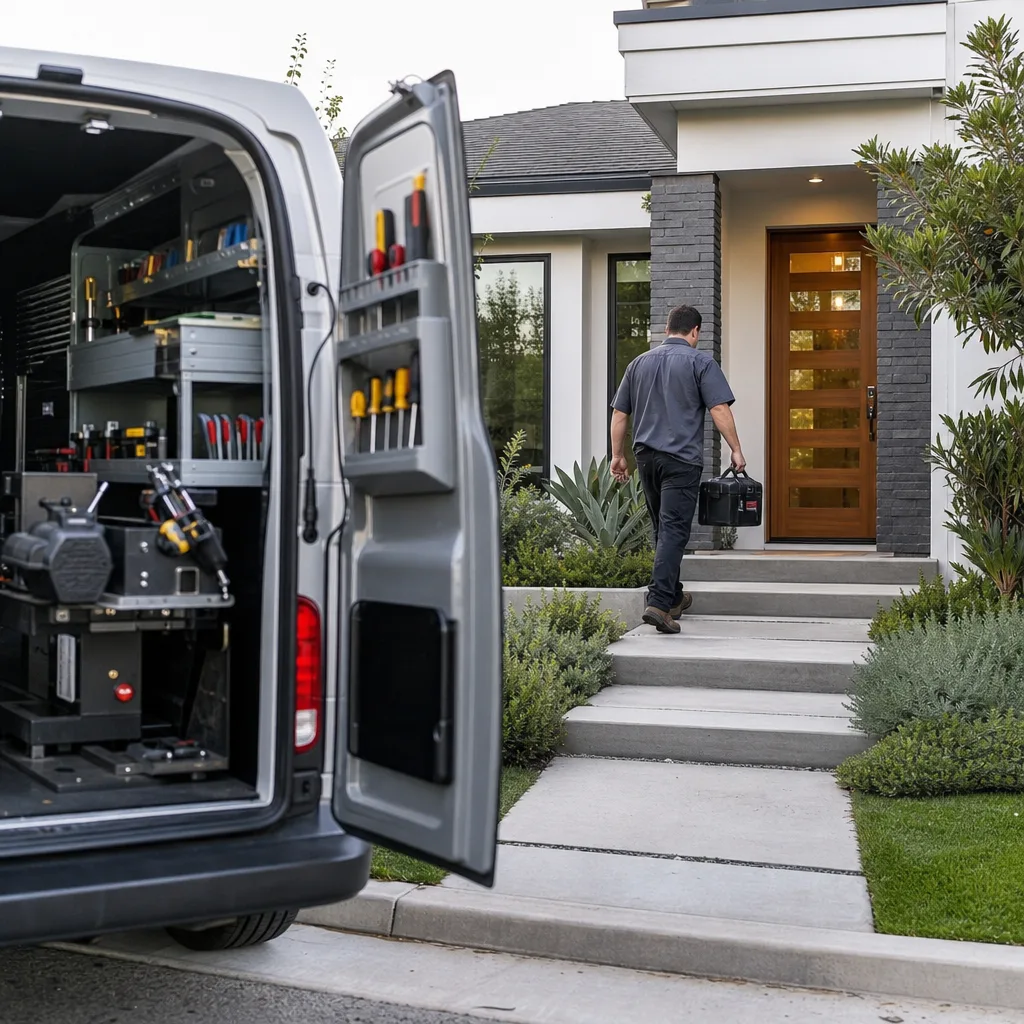
Some signals are definitive. If you encounter any of the following during your hiring process, discontinue contact and select another contractor:
- No CSLB license number provided - or the number belongs to a different company name when you check
- Refusal to provide a written scope - “Our technician will explain everything when they arrive”
- Insurance certificate unavailable - or coverage that excludes “locksmith” or “security equipment” operations
- Price quoted without lock description - “Rekeys are always $X” regardless of cylinder type, quantity, or condition
- Cash-only payment demanded - legitimate contractors accept checks and cards; cash-only suggests off-books operation
- No company-branded vehicle - unmarked vans are common among unlicensed operators who rotate through multiple business names
- Technician arrives without uniform or ID - background checks are meaningless if you cannot verify who is at your door
We’ve responded to calls in Hollywood Hills where the customer had already paid an unmarked van operator who damaged their Baldwin entry set and disappeared. The hardware cost $800 to replace. The “locksmith” had no license, no insurance, and no fixed address. CSLB complaints against such operators are common; recovery is rare.
Los Angeles-Specific Considerations
The Los Angeles market has characteristics that affect locksmith selection beyond the universal checks.
Neighborhood security profiles vary significantly. In Bel Air and Brentwood, we regularly see requests for high-security cylinders and decorative hardware that meets both aesthetic and insurance requirements. In Downtown LA and Koreatown, multi-unit buildings need master key systems that comply with fire egress codes while maintaining tenant security. In Venice and Santa Monica, salt air corrosion affects exterior hardware lifespan; we specify marine-grade finishes where standard plating fails within two years.
Permit requirements are often overlooked. Los Angeles Department of Building and Safety requires permits for new lock installations on commercial properties and for any work affecting fire-rated assemblies. A locksmith who suggests “we can skip the permit to save money” is exposing you to code violation liability. Legitimate contractors pull permits as standard procedure on qualifying work.
HOA and building management coordination is common in LA’s dense neighborhoods. In Century City and Westwood high-rises, locksmiths must coordinate with building engineers and provide certificates of insurance naming the HOA as additional insured. An operator unfamiliar with this process will delay your job or fail to complete it.
Traffic and dispatch reality. A company promising “15 minutes” from Van Nuys to Silver Lake is lying about their location or their capability. Honest dispatchers quote realistic windows based on current traffic conditions. At Novak, we quote arrival windows we can meet, and update you if conditions change.
For commercial locksmith work in Los Angeles, these factors compound. Access control integration, ADA compliance on automatic operators, and fire department coordination for Knox Box installations all require specific experience. Ask for comparable completed projects, not just years in business.
Common Mistakes to Avoid
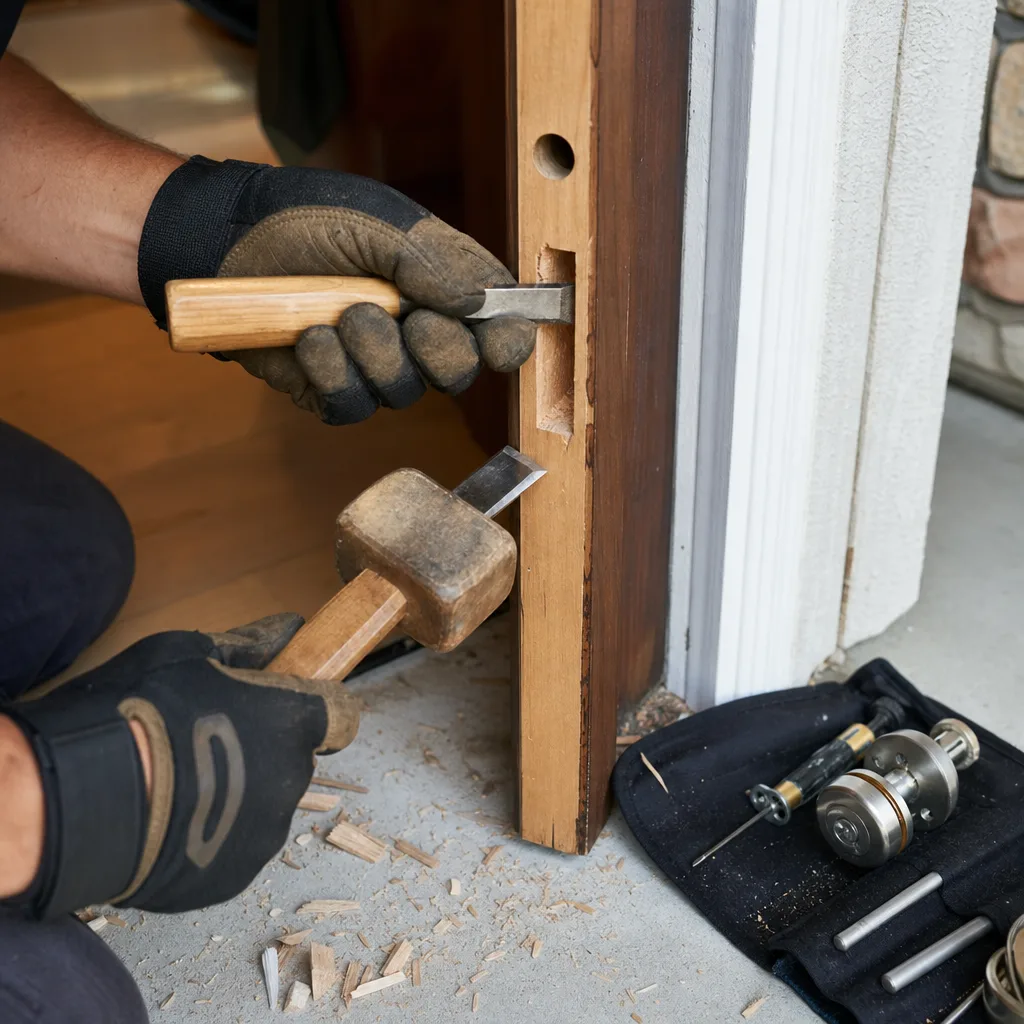
- Checking only the company name, not the technician. The CSLB license belongs to the business entity; the person at your door may be an unregistered employee or subcontractor. Ask for the technician’s name and verify they are associated with the licensed entity.
- Accepting “bonded” as sufficient. A contractor’s bond protects the state and consumers against financial loss from licensed contractors; it is not insurance and does not cover property damage or injury. Demand both the bond confirmation and the liability COI.
- Ignoring hardware grade. Grade 3 locks are residential minimum; Grade 2 is standard for light commercial and high-traffic residential; Grade 1 is heavy commercial. A locksmith installing Grade 3 on a commercial door in Los Angeles is either uninformed or cutting corners.
- Not requesting key codes. For standard pin-tumbler locks, the key code allows a future locksmith to create keys without disassembling the lock. For restricted systems like Mul-T-Lock, the registration card is essential. Losing either creates avoidable expense.
- Hiring based on lowest price alone. In Los Angeles, the spread between legitimate and illegitimate operators is $50-$100 on common jobs. The illegitimate operator’s final bill, after upsells and fabricated complications, typically exceeds the legitimate quote. Price is a filter, not a decision.
- Skipping documentation review at completion. The technician is at your door; you are relieved the job is done. This is when documentation errors occur - wrong key count, missing serial numbers, unchecked invoice items. Review before signing.
- Assuming all locksmiths do all work. Automotive key programming, safe servicing, access control integration, and decorative hardware installation are distinct specialties. A residential rekey specialist may lack the equipment or training for your specific need.
When to Call a Professional
Some situations permit delay for thorough vetting. Others require immediate response with verification done in parallel.
Call a professional locksmith now if you are locked out with dependents or pets inside, if a break-in has compromised your locks, if a key is broken off in a primary entry lock, or if a safe containing critical documents or medication will not open. In these cases, run the CSLB check while on the phone with the dispatcher, request the COI by email during the call, and confirm the written scope will arrive before the technician departs.
For planned work - rekeying after a move, upgrading hardware, installing residential locksmith systems in Los Angeles, or master keying a rental property - take the full time to verify. The ten minutes of credentialing described in this guide prevents weeks of dispute resolution.
Novak Lock & Security Los Angeles offers free estimates in Los Angeles - call (213) 632-4875. Every estimate includes a written scope, firm pricing under Haven Standard Clause 1, and verification of all credentials on request.
Frequently Asked Questions
Residential rekeying typically runs $25-$45 per cylinder, lock installation ranges $120-$200 for standard deadbolts, and emergency lockouts generally cost $85-$150. See our Locksmith Cost Breakdown: The Los Angeles Homeowner’s Reference for 2026 for detailed pricing analysis. Your exact price is quoted in writing before dispatch, with no call-out surcharge added on arrival. Call (213) 632-4875 for a specific quote - estimates are free.
At Novak Lock & Security, yes - Haven Standard Clause 1 prohibits the technician from changing the price at your door. This rule has been in place since 2002. If you are considering another contractor, ask directly whether their technician has authority to modify the quoted price. A verbal “we don’t do that” is insufficient; request the no-change policy in writing.
Search the company name and the individual technician name at checkthelicensefirst.com. Verify Active status, current bond, and C-28 classification. The check takes under two minutes. Any hesitation in providing a license number is a definitive signal to hire elsewhere.
You should receive an itemized invoice matching the pre-job scope, hardware documentation with model and serial numbers, a key record with quantities and codes, a dated photo record of completed work, and written warranty terms. At Novak, all five are provided as standard on every job, not as upgrades.
For work under $500, yes - but lock installation, rekeying, and security hardware work affect your insurance coverage, fire code compliance, and warranty status. A handyman’s general liability policy typically excludes locksmith operations. For anything involving your primary security, the C-28 license and specific insurance coverage are worth the verification time.
Realistic arrival windows vary by traffic, time of day, and your location relative to the company’s dispatch point. In our experience, promises under 20 minutes for cross-town travel are unreliable. Honest dispatchers quote 30-60 minute windows for emergency calls and meet them. Ask for the technician’s current location and estimated travel time based on live traffic data.
The Bottom Line
Hiring a locksmith in Los Angeles is a credentialing exercise first. Verify the C-28 license for both company and technician. Demand a written scope with itemized pricing before dispatch. Confirm insurance specifically covers locksmith operations. Lock in a contractually firm quote with no-change protection. And require complete post-job documentation. These steps take ten minutes and eliminate most fraudulent operators. Price becomes relevant only after legitimacy is established. A low quote from an unlicensed technician can cost you your insurance coverage, your security, and any legal recourse when the work fails.
Written by Daniel Novak, Owner at Novak Lock & Security Los Angeles, serving Los Angeles since 2002.