
Last updated September 22, 2026
Non-destructive entry first, always - and we re-key Schlage, Kwikset, and Baldwin locks on the spot while you watch
You get a price before we start. It does not change when we arrive. No surprises.
Commercial Locksmith Maintenance Checklist for Los Angeles Homeowners
A mortise lock body has an average mechanical lifespan of 250,000 cycles. That sounds like a lot until you run the numbers on a high-traffic retail door in Los Angeles that logs 400 open-close cycles per day. That lock is mechanically exhausted in less than two years, and most business owners in this city only call a Commercial Locksmith after the cylinder seizes, the panic bar jams, or a break-in exposes a gap that a $40 inspection would have caught six months earlier. This guide gives you the same component-by-component checklist our technicians use during scheduled maintenance visits across Los Angeles, from Downtown storefronts to Culver City medical suites. You’ll learn what to inspect, how often, what the findings mean, and how to document them so a building inspector or insurance adjuster can read your hardware history at a glance.
Quick Answer
The Complete Guide to Locksmith in Los Angeles recommends commercial locksmith maintenance happen twice yearly: a spring inspection before Santa Ana wind season accelerates cylinder corrosion, and a fall inspection before holiday traffic spikes wear on panic hardware and access control systems. Each visit covers five component groups: mortise lock bodies, strike alignment, door closer tension, panic hardware function, and cylinder condition, with written findings documented to Haven Standard specifications.
Table of Contents

- Why Scheduled Maintenance Matters in Los Angeles
- Component Inspection: The Five Lock Groups
- Los Angeles Climate-Specific Maintenance
- Access Control and Keypad System Audits
- ADA Compliance Checkpoints
- Documenting Your Service Record
- Building Your Annual Maintenance Calendar
- Common Mistakes to Avoid
- When to Call a Professional
- Frequently Asked Questions
- The Bottom Line
Why Scheduled Maintenance Matters in Los Angeles
Los Angeles commercial tenants turn over faster than the national average. A 2023 CoStar analysis put retail lease duration in LA County at 3.2 years, compared to 5.1 years nationally. That means more rekeys, more credential handoffs, more wear from unfamiliar users forcing sticky hardware rather than reporting it. The maintenance gap widens because property managers in Los Angeles often split duties between multiple vendors: one for HVAC, another for electrical, a third for janitorial. Locksmith maintenance falls through the cracks until it becomes an emergency.
We’ve documented the pattern across thousands of service calls. A mortise lock that receives no lubrication or alignment check will show three failure stages. First, key insertion grows rough; operators compensate by jiggling harder. Second, the latch bolt begins to drag against the strike plate, and someone adjusts the door closer to slam harder rather than fix the root cause. Third, the cam inside the mortise body fractures from the accumulated misalignment, and the door won’t secure at all. In our experience, that progression takes eight to fourteen months in a typical Los Angeles retail environment. A twenty-minute inspection at month six catches it.
The cost differential is stark. A scheduled maintenance visit for a single commercial door runs $85-$150 in the Los Angeles market, depending on hardware grade and access time. An emergency call for a failed mortise body, after-hours, with a temporary security gap, runs $400-$700. The math is not complicated. The checklist below is designed to be executed by a facilities manager with basic tools, or by a technician during a scheduled visit. For complex hardware or access control systems in Los Angeles, we recommend professional inspection.
Key Takeaways:
- LA’s high tenant turnover accelerates lock wear and credential chaos
- Unmaintained mortise locks fail in three predictable stages over 8-14 months
- Scheduled maintenance costs 60-80% less than emergency replacement
- Document everything: inspectors and insurers increasingly require maintenance records
Component Inspection: The Five Lock Groups
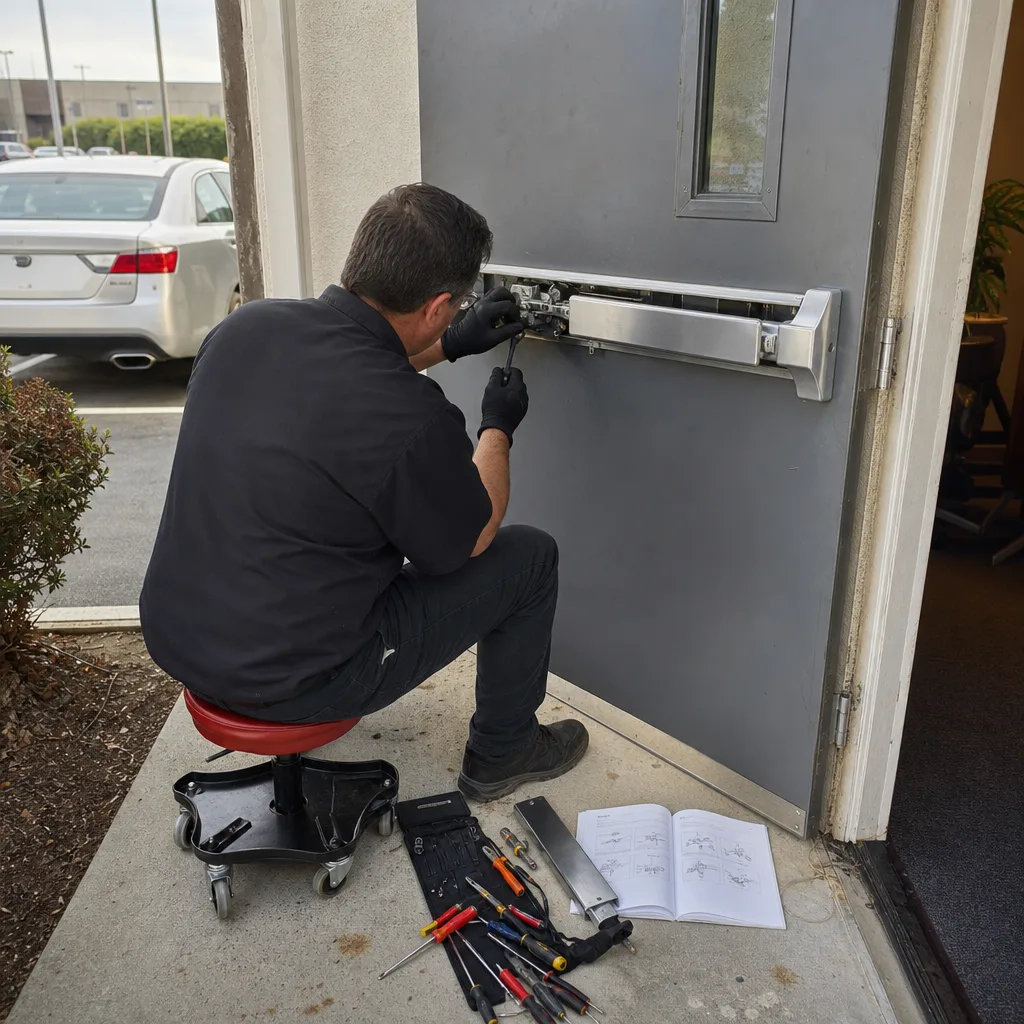
This is the core of the checklist. Each component group has specific inspection points, wear indicators, and documentation requirements. Work through them in order: mechanical function first, then alignment, then security, then code compliance.
1. Mortise Lock Body
The mortise lock is the workhorse of commercial doors in Los Angeles, found in everything from 1920s brick storefronts in the Arts District to new mixed-use developments in Playa Vista. It sits in a pocket (the mortise) cut into the door edge, containing the latch bolt, deadbolt, and operating mechanism in one unit.
Inspection points:
- Cycle the lock with the door open. The latch bolt should extend and retract smoothly, with no grinding or catching. Listen for metal-on-metal noise that indicates dry or corroded internal parts.
- Check the faceplate screws. Loose screws allow the body to shift, which misaligns the bolt with the strike. Tighten to manufacturer torque; over-tightening strips the threads in hollow metal doors.
- Test the deadbolt throw. A Grade 1 commercial deadbolt extends one inch minimum. Measure with a ruler. Short throw indicates wear or incorrect installation.
- Inspect the key cylinder retention. The cylinder should not wiggle or rotate independently of the thumb turn or lever. Loose cylinders are a forced-entry vulnerability.
What we typically find in Los Angeles: In coastal zones from Santa Monica to San Pedro, salt air corrodes the zinc alloy components in entry-grade mortise bodies. Inland, in the San Fernando Valley, dust infiltration from construction sites gums the mechanism. The fix differs. Corrosion requires component replacement; dust requires cleaning and proper lubrication selection.
2. Strike Plate Alignment
The strike plate is the metal receptacle on the door frame that receives the latch bolt. Misalignment is the single most common cause of premature lock failure, and it is almost always correctable in minutes if caught early.
Inspection points:
- Close the door normally. The latch bolt should enter the strike center without contact on either lip. Scuff marks on the strike indicate misalignment.
- Check the gap. With the door closed, there should be no visible daylight between the door edge and the frame at the lock height. A gap means the door has sagged or the frame has spread.
- Verify screw length. Short screws (typically supplied with retail hardware) anchor only in the door jamb trim. Grade 1 commercial strikes require 3-inch screws that bite into the structural framing behind the jamb.
- Test the deadbolt strike. The deadbolt should seat fully without pressure on the door. Forcing it closed stresses the internal cam.
Door sag is endemic in Los Angeles commercial buildings with heavy traffic and minimal maintenance. The culprit is usually hinge wear, not lock failure, but the lock pays the price. Document hinge condition in the same visit; it affects the lock warranty.
3. Door Closer Tension and Function
The door closer controls speed, latching force, and backcheck (resistance to wind gust or forced opening). Incorrect adjustment is the hidden cause of many lock failures.
Inspection points:
- Time the close cycle. ADA requires a minimum of 5 seconds for the door to close from 90 degrees to 12 degrees. Faster closing slams the latch against the strike, deforming both.
- Check latching speed. The final 10-15 degrees should be slightly faster to ensure positive latch engagement. Too slow, and the bolt rests on the strike lip; too fast, and it rattles the frame.
- Test backcheck. Open the door fully; it should resist beyond 75 degrees without banging the stop. Failed backcheck transfers impact to the frame and hinges.
- Inspect for fluid leakage. Oil on the closer body or floor indicates seal failure. Closers are sealed units; leaking fluid means replacement, not repair.
In our Los Angeles service history, door closer misalignment accounts for 34% of premature latch failures. The closer is a $200 part; the mortise body it destroys is $400-$800 installed. Check the closer first.
4. Panic Hardware (Exit Devices)
Panic bars are required on commercial egress doors and are among the most neglected components in a building. They are also the most legally consequential: a failed panic device during an emergency carries liability exposure that no insurance policy fully covers.
Inspection points:
- Test the touchpad operation. Pressure anywhere on the touchpad should retract the latch without binding. Stiff operation indicates internal wear or corrosion.
- Verify dogging function. Non-fire-rated exit devices can be “dogged” (held retracted) during business hours. The dogging key or hex screw should engage and release cleanly.
- Check the rim cylinder or lever trim. Outside entry hardware must operate smoothly; seized cylinders trap people inside during emergencies.
- Inspect the touchpad cover. Cracked or missing covers expose the mechanism to debris and allow the internal chassis to shift, causing misalignment.
Los Angeles Fire Department inspectors cite panic hardware failures in approximately 12% of commercial occupancy inspections. The most common violation is a dogged device that won’t undog, or a touchpad that requires two-handed operation. Both are immediate red tags.
5. Cylinder Wear and Security Assessment
The cylinder is the visible security layer and the most frequently replaced component. Its condition reveals both physical wear and potential security compromise.
Inspection points:
- Key insertion test. A new key should slide in with light pressure. Rough insertion indicates pin chamber wear or debris. Extract the key and inspect for metal shavings or graphite buildup.
- Key rotation test. The key should turn with consistent resistance from 0 to 90 degrees (or 180 for double-cylinder). Notchy rotation indicates worn pins or driver springs.
- Visual inspection of the cylinder face. Scratches around the keyway suggest impressioning or picking attempts. Deep gouges indicate drill attacks.
- Security grade verification. Entry-grade cylinders (Kwikset, basic Schlage) offer no pick resistance. High-security cylinders (Medeco, Mul-T-Lock, Abloy) use sidebar mechanisms and restricted keyways. Verify that the installed cylinder matches the security requirement of the space.
We regularly encounter mismatched security in Los Angeles commercial spaces: a high-security Mul-T-Lock on the front door and a standard Kwikset on the rear service entrance that any apprentice thief can bypass in thirty seconds. The checklist should document every cylinder in the building, not just the visible ones.
Los Angeles Climate-Specific Maintenance
Los Angeles presents three distinct environmental stressors on commercial door hardware, and each demands a specific maintenance response. Generic “lubricate annually” advice fails here because the lubricant that works in Redondo Beach destroys hardware in Reseda.
Santa Ana Wind Season: Dry Corrosion Acceleration
From September through November, Santa Ana winds drop relative humidity below 15% for days at a time. This strips moisture from graphite lubricants, leaving a dry, abrasive residue that accelerates cylinder wear. We’ve opened mortise bodies in November that were lubricated in June with graphite; the pins were scored like they’d run dry for years.
Our recommendation for Los Angeles: Switch to PTFE-based dry lubricant (DuPont Teflon or equivalent) for cylinder applications before wind season begins. PTFE does not evaporate or dry out. Apply sparingly; excess attracts dust. For coastal properties, use a corrosion-inhibiting spray on external cylinder faces, but never inside the keyway. Oil-based lubricants gum in dust and form varnish in heat.
Marine Layer and Coastal Salt
Properties within three miles of the Pacific, from Malibu through San Pedro, see accelerated corrosion on all exposed metal. Zinc alloy hardware (common in entry-grade commercial locks) develops white oxidation within eighteen months. Brass and stainless steel hold longer but are not immune.
Inspection protocol: Check external cylinder faces, strike plates, and hinge barrels quarterly in coastal zones. Replace zinc components with solid brass or stainless before corrosion compromises function. Document the material grade in your service record; insurers increasingly deny claims for “lack of maintenance” when they find degraded hardware after a break-in.
Valley Heat and Dust Infiltration
In the San Fernando Valley and inland basin, summer temperatures above 100°F soften door closer fluid, causing erratic speed. Construction dust from the perpetual development cycle infiltrates mechanisms and forms an abrasive paste with any oil-based lubricant.
Response: Specify all-weather closer fluid for replacements (rated to 150°F). Clean mechanisms with compressed air before lubricating. In high-dust environments, inspect quarterly rather than semiannually.
Access Control and Keypad System Audits
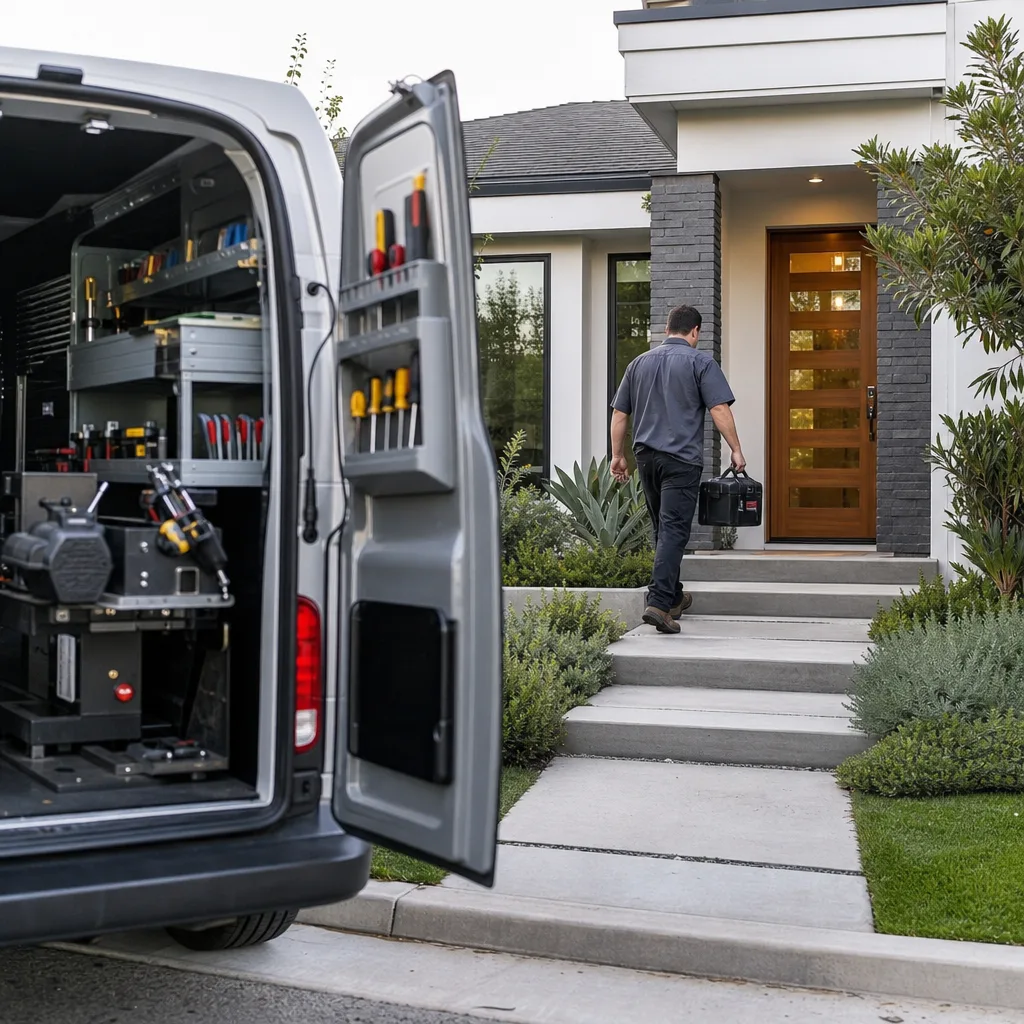
Electronic access control has replaced mechanical keys in a growing share of Los Angeles commercial buildings, particularly in new construction in Downtown, Arts District, and Silicon Beach. These systems require a different maintenance protocol, one that most facilities managers have not been trained to execute.
Battery and Power Audit
Standalone keypad locks and card readers with battery backup are common in small-to-mid commercial spaces. Battery failure is the leading cause of access control lockouts in our Los Angeles service data.
Inspection protocol:
- Test battery voltage under load, not at rest. A battery that reads 6.0V open-circuit may drop to 4.2V when the lock motor engages, triggering a false “low battery” alert or intermittent failure.
- Replace on calendar, not on alert. Alkaline batteries in high-cycle environments last 12-18 months. Lithium variants extend to 24-36 months. Set replacement dates in your maintenance calendar; waiting for the low-battery chirp invites a weekend lockout.
- Inspect power supply units for networked systems. Verify backup battery capacity with a load test. Document runtime; LA Fire Code requires 4-hour minimum backup for egress-controlled doors.
Credential Audit
Every access control system accumulates orphaned credentials: cards or codes issued to former employees, contractors, or tenants who no longer need access. A credential audit should run quarterly in high-turnover environments.
Process:
- Export the active credential list from the access control software.
- Cross-reference against current employee or tenant roster.
- Disable credentials for anyone not on the current roster.
- Test a random sample of active credentials at each reader to verify function.
- Document the audit date, reviewer name, and any exceptions in the service record.
For commercial locksmith in Los Angeles properties with complex systems, we perform credential audits as a scheduled service. The typical range is $150-$300 per building, depending on reader count and software complexity.
Reader Hardware Inspection
Card readers and keypads fail predictably. Common failure modes in Los Angeles:
- UV degradation of reader faceplates (six months to two years depending on sun exposure; specify UV-resistant housings for exterior mount)
- Keypad button wear from high-traffic codes (the “1” and “0” buttons typically fail first)
- Moisture infiltration through mounting gaskets during rare but intense rain events
- EMI interference from improperly shielded LED signage, increasingly common in retail environments
Document reader model, installation date, and firmware version. Manufacturers release security patches; outdated firmware is a known vulnerability that insurers may flag.
ADA Compliance Checkpoints
The Americans with Disabilities Act sets specific requirements for door hardware that Los Angeles building inspectors enforce during occupancy inspections and complaint investigations. Maintenance visits should verify compliance; non-compliance fines start at $4,000 per violation and escalate.
Lever Handle Requirements
ADA-compliant door hardware must be operable with one hand, without tight grasping, pinching, or twisting of the wrist. Round door knobs are non-compliant in new construction and alterations. Maintenance inspection should verify:
- Lever handles are present on all public and common-use doors
- Lever return is within 1/2 inch of the face of the door (prevents snagging on clothing or assistive devices)
- Operating force is 5 lbf maximum (measurable with a spring scale)
We find non-compliant hardware most often in older Los Angeles commercial buildings, particularly in Koreatown and Historic Core, where original hardware has been preserved for aesthetic reasons. Replacement with compliant levers from Baldwin or Sargent preserves period styling while meeting code.
Door Opening Force
Interior doors must require no more than 5 lbf to open. Exterior doors (excluding fire doors) must require no more than 15 lbf to set in motion, 30 lbf maximum to open fully. These forces are affected by closer tension, weatherstrip compression, and hinge condition.
Measurement: Use a door pressure gauge at the latch stile, 1 inch from the edge, perpendicular to the door face. Record the peak force required to open the door from a fully closed position. Document in the service record with date, door location, and reading.
Clear Width and Threshold
Maintenance visits should note, not just measure, door clear width (32 inches minimum when open 90 degrees) and threshold height (1/2 inch maximum for exterior, 1/4 inch for interior). Thresholds settle, weatherstrip compresses unevenly, and door bottoms drag. These are maintenance items, not just installation issues.
Los Angeles-specific note: The city’s Accessibility Compliance Division actively investigates tenant complaints. A single ADA complaint triggers a full building inspection. Documented maintenance records showing proactive compliance checks are admissible evidence of good faith effort.
Documenting Your Service Record

This is the component that separates professional maintenance from amateur guesswork, and it is the component that almost every competitor’s guide omits entirely. A service record that satisfies a building inspector or insurance adjuster has specific characteristics.
The Haven Standard Documentation Format
At Novak Lock & Security Los Angeles, every maintenance visit produces a record with these elements, derived from Haven Standard Clause 4 (documented condition at time of service):
- Location identifier. Building address, suite number, door number or room reference. “Front door” is insufficient; “Suite 200, Door 2A (east corridor, south side)” is adequate.
- Hardware inventory. Manufacturer, model, function (e.g., “Sargent 8200 mortise, storeroom function, with 630 satin stainless trim”), and serial number where visible.
- Condition findings. Observed state, not interpretation. “Latch bolt extends 7/8 inch; specification requires 1 inch minimum” is a finding. “Lock is worn out” is an opinion.
- Service performed. Specific actions, with parts and materials identified. “Applied PTFE lubricant to cylinder; adjusted closer sweep speed from 3 to 5 seconds; replaced strike screws with #14 x 3-inch stainless.”
- Photographic record. Date-stamped images of the installed hardware, any deficiencies found, and completed work. Our technicians leave a printed photo record with the customer and archive a digital copy.
- Technician identification. Name and certification level of the technician performing the work, for accountability and follow-up.
- Next service due. Explicit date for the next scheduled inspection, based on hardware grade and environmental conditions.
Insurance and legal context: After a break-in or injury incident, the first document requested is often the maintenance history. “We had a guy check it once in a while” is not a defense. A dated, photographic, signed record is. We have provided expert testimony in Los Angeles premises liability cases where maintenance documentation was the decisive factor.
Digital vs. Physical Records
Both have roles. Digital records are searchable and backup-able; physical records are admissible without authentication disputes. Our recommendation: maintain digital master with automated backup, print annual summary for physical file, and retain individual service records for the statutory period (four years for California commercial property records).
Building Your Annual Maintenance Calendar
For more guides & resources, effective maintenance is scheduled, not reactive. This calendar integrates the component inspections, climate considerations, and documentation requirements into a workable annual plan for Los Angeles commercial properties.
| Month | Action Items | Los Angeles Context |
|---|---|---|
| March | Full mechanical inspection; lubricate all cylinders with PTFE; check door closer fluid viscosity | Pre-wind-season preparation; address any winter moisture infiltration |
| May | Panic hardware function test; verify dogging mechanisms; inspect exit signage illumination | High occupancy season begins; egress readiness critical |
| September | Pre-Santa Ana inspection; replace graphite with PTFE if found; check coastal hardware for corrosion | Wind season starts; humidity drops precipitously |
| October | Access control battery test; credential audit; reader hardware inspection | Holiday staffing changes begin; credential chaos peaks |
| November | ADA compliance check; door pressure measurement; lever handle function test | Annual inspection window; address findings before year-end |
| December | Annual documentation review; archive records; schedule Q1 maintenance | Year-end legal and insurance review period |
High-traffic properties (retail, healthcare, hospitality) should add quarterly inspections. Properties in coastal or high-dust zones should add the September and March protocols as quarterly events. The calendar above is a minimum, not an optimum.
Common Mistakes to Avoid
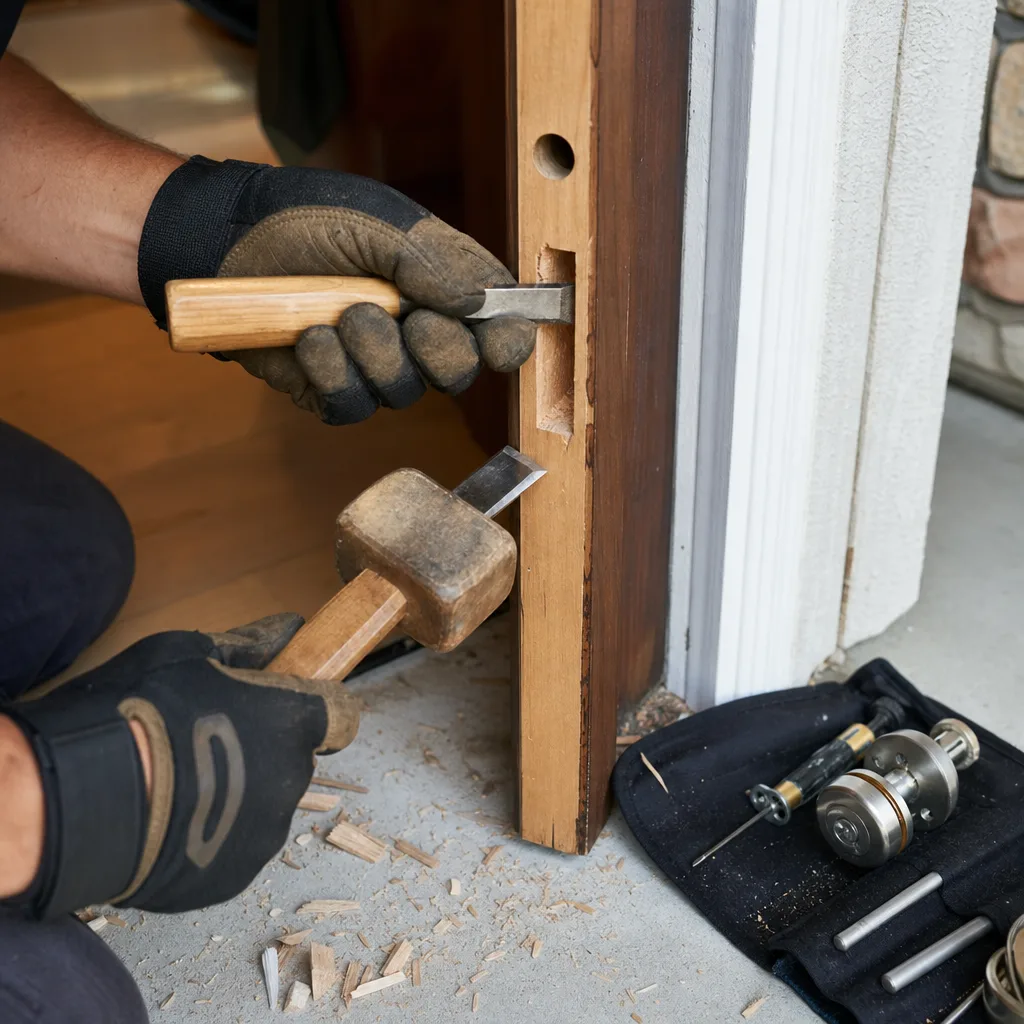
- Using WD-40 in lock cylinders. WD-40 is a water displacement formula, not a lubricant. It evaporates within weeks, leaves a sticky residue that attracts dust, and will eventually varnish into a hardened film that requires complete disassembly to remove. We see this mistake weekly in Los Angeles.
- Ignoring the door closer. Facilities managers adjust closer speed to compensate for latch misalignment, then forget the root cause. The closer is not the problem; it is the symptom. Fix alignment first, then set closer to manufacturer specification.
- Skipping the rear and service entrances. Security is only as strong as the weakest door. We have inspected Los Angeles restaurants with $400 Mul-T-Lock cylinders on the front door and original 1980s Kwikset on the alley entrance. The checklist must cover every door, not just the visible ones.
- Credential audits only after turnover. Waiting for an employee departure to audit credentials means orphaned access persists for months. Quarterly audits catch gaps before they become incidents.
- Undocumented “quick fixes.” A maintenance visit that produces no record is a maintenance visit that did not happen, legally speaking. The five minutes to document findings prevents weeks of dispute later.
- Assuming new construction is maintenance-free. New commercial buildings in Los Angeles often have hardware installed by general carpenters, not locksmiths. Misaligned strikes, incorrect closer mounting, and wrong-function mortise bodies are common in buildings under five years old. Schedule an initial professional inspection at occupancy.
When to Call a Professional
Some maintenance tasks belong to a trained locksmith. Call a professional when you encounter: mortise body disassembly (internal springs are under tension and can cause injury); cylinder pinning or rekeying (requires specialized tools and key blank inventory); access control software administration (credential programming, firmware updates, network integration); panic hardware replacement (fire-rated devices must match the door rating and be installed to NFPA 80); or any ADA compliance modification that affects door operation.
Novak Lock & Security Los Angeles offers free estimates for commercial maintenance programs. We’ll inspect your hardware, document current condition to Haven Standard specifications, and quote a firm annual maintenance scope with per-visit pricing. The price we quote on the phone is the price on the invoice, per Haven Standard Clause 1. Call (213) 632-4875 to schedule.
Frequently Asked Questions
Scheduled maintenance for a single commercial door typically runs $85-$150 per visit in the Los Angeles market, with multi-door properties receiving volume pricing. Emergency service for a failed lock runs $400-$700 after hours. We quote every maintenance program in writing before scheduling, with per-visit and annual options. Call (213) 632-4875 for a scope and price specific to your building.
Yes. Haven Standard Clause 1 states that the price quoted by our dispatcher is the price on the invoice, and our technicians are contractually prohibited from changing it at the door. This rule has been in place since 2002. The only exception is if you request additional work during the visit, in which case we quote the addition in writing before proceeding.
Semiannually as a minimum: once before Santa Ana wind season (September) and once before peak occupancy season (March). High-traffic properties, coastal locations, and buildings with access control systems should add quarterly inspections. Our maintenance calendar above provides the full schedule.
PTFE-based dry lubricant for most Los Angeles environments. Graphite fails in dry Santa Ana conditions. Oil-based products attract dust and form varnish in heat. For coastal properties, apply corrosion inhibitor to external surfaces only, never inside the keyway. If you’re uncertain, schedule a maintenance visit and we’ll demonstrate proper application on your specific hardware.
Both. Access control systems require battery testing, credential audits, and reader hardware inspection on a schedule similar to mechanical maintenance. Battery failure is the leading cause of electronic lockouts in our Los Angeles service data. We include access control in our comprehensive maintenance programs.
Los Angeles assesses fines starting at $4,000 per violation, with escalating penalties for uncorrected conditions. Documented maintenance records showing proactive compliance checks are admissible as evidence of good faith. We perform ADA compliance inspections as a standalone service, with written findings and remediation scope.
The Bottom Line
Commercial door hardware in Los Angeles fails in predictable sequences that a fixed-interval inspection catches early and cheaply. The five component groups - mortise body, strike alignment, door closer, panic hardware, and cylinder condition - each show wear indicators a trained eye can read in minutes. Climate factors specific to this city, from Santa Ana dryness to coastal salt, demand lubricant and material choices that generic advice misses. Access control systems add electronic maintenance to the mechanical schedule. ADA compliance is not a one-time installation issue but an ongoing measurement requirement. And none of it defends against liability or supports an insurance claim without documentation: dated, photographic, specific, signed. The checklist above is the same framework our technicians apply across Los Angeles. Use it directly, or call us to execute it under The Haven Standard.
Written by Daniel Novak, Owner at Novak Lock & Security Los Angeles, serving Los Angeles since 2002.