
Last updated September 22, 2026
Non-destructive entry first, always - and we re-key Schlage, Kwikset, and Baldwin locks on the spot while you watch
You get a price before we start. It does not change when we arrive. No surprises.
Locksmith Warning Signs: A Los Angeles Homeowner’s Reference Guide
The most reliable predictor of a locksmith scam in Los Angeles isn’t the technician’s behavior at your door. It’s the name discrepancy between the company you searched, the name on the phone, and the name on the van that shows up, which are often three different entities. In 23 years of serving Los Angeles, we’ve documented how these operations work: a national call center buys local ads, farms the job to an unvetted subcontractor, and the homeowner pays 3-5x the fair rate with no recourse. This guide shows you the exact warning signs at every stage, from your first Google search to the moment someone knocks, so you can stop the scam before it starts. For more guides & resources, see our blog.
Quick Answer
The warning signs of a predatory locksmith in Los Angeles follow a predictable sequence: search results with no verifiable local address, phone quotes that refuse to name a total price, technicians arriving in unmarked vehicles with mismatched names, and mid-job “discoveries” that inflate the bill. A legitimate Los Angeles locksmith provides a written price before dispatch, arrives in a marked vehicle with a uniformed technician whose name you were given, and never changes the quoted amount at the door. For year-round maintenance tips, read our Seasonal Locksmith Care for Los Angeles: Year-Round Homeowner’s Guide.
Table of Contents

- Search-Phase Red Flags: Before You Call
- Phone-Call Red Flags: The Dispatch Conversation
- Arrival Red Flags: The Technician at Your Door
- Mid-Job Red Flags: The Discovery Upsell
- Your Legal Options in California
- What a Legitimate Locksmith Looks Like
- Common Mistakes to Avoid
- When to Call a Professional
- Frequently Asked Questions
Search-Phase Red Flags: Before You Call
Los Angeles is one of the most competitive locksmith markets in the country, and the search results reflect that. Scam operations spend heavily on Google Ads to outrank local businesses, then use deceptive listings to capture desperate customers. Here’s what to look for before you dial.
No Physical Address or a Suspicious One
Legitimate locksmiths maintain a real shop or at minimum a verifiable commercial address. If the website lists only a service area with no street address, or the address turns out to be a mailbox in a strip mall or a residential apartment when you check Google Street View, that’s a significant signal. In Los Angeles, we’ve seen scam listings use addresses that map to parking lots, closed businesses, or buildings with no signage.
Check the address yourself. Type it into Google Maps and look at Street View. A real locksmith serving Los Angeles for any length of time will have a visible presence: signage, branded vehicles in the lot, or at minimum a commercial suite number that matches the business name.
Local Area Code, National Call Center
A 213, 310, 323, or 424 area code means nothing if the person who answers is reading from a script in another state. Here’s how to test it: ask a specific question about Los Angeles geography. “I’m near the intersection of Venice and La Brea - how long to get a technician here?” A local dispatcher knows that intersection is in Mid-City. A national call center will pause, type, and give you a generic estimate.
We’ve taken calls from customers who were routed through centers in Florida and Arizona before a subcontractor in an unmarked van was dispatched to Silver Lake or Studio City. The area code was local. The operation was not.
Review Volume That Doesn’t Match the Evidence
A locksmith with 500+ Google reviews in two years is possible but warrants scrutiny. Look for these specific patterns:
- Reviews that mention generic technician names (“Mike was great,” “Thanks John”) with no photo evidence of actual work
- No responses from the business to negative reviews - a common sign of a listing that’s been purchased or is managed remotely
- Reviews clustered in a short time period, then silence
- Multiple five-star reviews posted on the same day with similar phrasing
A legitimate Los Angeles locksmith will have reviews that mention specific neighborhoods: “came to our place in Los Feliz,” “rekeyed our new house in Eagle Rock,” “installed a Medeco deadbolt in our Hancock Park home.” The reviews will reference real hardware, real situations, and real outcomes.
Stock Photos Instead of Documented Work
Every photo on a scam locksmith’s website is purchased from a stock library: the smiling technician with perfect lighting, the generic van with no logo, the lock that could be anywhere. A real Los Angeles locksmith has photos of actual jobs: the Schlage deadbolt installed in a Pasadena Craftsman, the rekey in progress at a Mid-Wilshire apartment building, the high-security cylinder upgrade in a Beverly Hills estate.
At Novak Lock & Security Los Angeles, we leave a documented photo record with every customer. That standard means we also have thousands of real images from real jobs across Los Angeles - not stock photography.
Phone-Call Red Flags: The Dispatch Conversation
The phone call is where most scams are sealed or prevented. A legitimate locksmith can and will name a price. A predatory operation will systematically avoid it.
The “Service Call Fee” Without a Total
This is the most common trap. The dispatcher quotes “$19 service call” or “$29 dispatch fee” and refuses to state what the actual work costs. The technician arrives, declares the lock “more complicated than described,” and the final bill runs $250-$600.
Here’s the rule: a legitimate locksmith can name a price range for standard work over the phone. Not an exact figure for every scenario, but a range. For common residential services in Los Angeles, fair pricing typically looks like this (see our Complete Guide to Locksmith in Los Angeles for more detail):
- House lockout, standard deadbolt: $85-$150
- Lock rekey, per cylinder (Schlage or Kwikset): $25-$45 plus trip charge
- Deadbolt installation, labor only: $75-$125
- High-security cylinder installation (Medeco or Mul-T-Lock): $200-$400 depending on door prep
If the dispatcher won’t put a number on the actual work, end the call. Haven Standard Clause 1: the price on the phone is the price on the invoice. We’ve operated under that rule since 2002.
Inability to Provide a CSLB License Number
In California, any locksmith performing work over $500 or advertising as a contractor must hold a CSLB license. Ask for the number. A legitimate operation provides it immediately. A scam operation will deflect: “We’re fully licensed,” “Our technicians carry all required credentials,” “The license is in the office.”
Write down the number and verify it at cslb.ca.gov. Check that the license status is “Active,” the classification includes locksmith or related work, and the business name matches what you were told. We’ve seen Los Angeles customers burned by technicians who presented expired licenses or licenses belonging to completely different companies.
Pressure to Commit Before Pricing
“We have a technician two minutes away - I just need your card to hold the slot.” This is a standard high-pressure tactic. The technician isn’t two minutes away. The card charge is a commitment device to prevent you from canceling when the real price emerges. A legitimate locksmith in Los Angeles does not require payment information to dispatch. We take your address, describe the work, name the price, and send the technician.
No Technician Name or ETA
A professional dispatch operation tells you who is coming and when. “Daniel will be there in 35 minutes, driving a white van with Novak Lock & Security on the side.” A scam operation gives you “a technician” and a vague window. The person who arrives may have no connection to the company you called.
Arrival Red Flags: The Technician at Your Door
The technician’s arrival is your last chance to stop a bad transaction before it begins. These are the specific signals to watch for.
Unmarked or Mismarked Vehicle
A legitimate locksmith arrives in a vehicle with permanent, professional signage: business name, phone number, license number if required. Magnetic signs that can be removed in seconds are a yellow flag. Completely unmarked vehicles are a red flag. In Los Angeles, we’ve heard from customers in neighborhoods like Los Feliz and Atwater Village who described technicians arriving in personal vehicles with no identification - sometimes with out-of-state plates.
Name Mismatch
You were told “Marcus” was coming. The person at your door introduces himself as “Dave” and seems unclear about who dispatched him. This is the name discrepancy pattern: the company you searched, the company on the phone, and the person at your door are three separate entities with no accountability chain. Ask directly: “What company do you work for?” If the answer doesn’t match what you searched or doesn’t match at all, do not proceed.
No Written Invoice Before Work Begins
This is non-negotiable. A legitimate technician presents a written invoice or work order with the agreed price before touching your lock. Not after. Not “I’ll write it up when I’m done.” Before. In 60,000+ jobs since 2002, we’ve never started work without written customer authorization of the price.
The invoice should include:
- Business name, address, and phone number matching what you searched
- CSLB license number if applicable
- Description of work to be performed
- Total price, itemized
- Technician name and signature line
If the technician claims the printer is broken, the system is down, or “we’ll email it later,” stop the job. These are standard delay tactics to prevent you from seeing the real charges until work is complete.
Uniform and Identification
Our technicians wear uniforms with the Novak name and carry photo identification. A technician in street clothes with no ID badge is not prepared to be in your home. In Los Angeles, where we’ve serviced homes from Venice to Highland Park, customers have the right to verify who they’re letting past their threshold.
Mid-Job Red Flags: The Discovery Upsell

The most sophisticated scams don’t happen at the door. They happen after the technician has started work, when you’re already committed and vulnerable. This is the discovery upsell, and it has specific patterns.
The “Unpickable” Lock
You called for a lockout. The technician arrives, attempts entry for 30 seconds, and declares your lock “unpickable,” “high-security,” or “damaged internally.” The solution: drill and replace, at 3-5x the quoted price. The reality: most residential locks in Los Angeles, even quality brands like Schlage and Kwikset, can be picked or bypassed by a skilled technician. Drilling should be a last resort, not a first option, and it requires your explicit written authorization.
Here’s how to distinguish a legitimate finding from a scam: a legitimate technician explains what they found, shows you the evidence, and stops work to discuss options and pricing before proceeding. “This Kwikset SmartKey has a failed sidebar - I can show you the mechanism. Drilling is the only entry method. A replacement with rekeying will be $X. Do you want to proceed?” A scam technician declares, starts drilling, and presents the inflated bill.
The “Damaged” Hardware That Wasn’t
A technician removes your deadbolt, claims the bolt or strike is damaged, and insists on replacement. The hardware was working fine when you locked it. Ask to see the damage. A legitimate technician will show you the cracked bolt, the worn cam, the bent latch. A scam technician will rush the removal, hide the part, and present a new lock at premium pricing.
In Los Angeles, where many homes built between 1920 and 1960 have original hardware, we’ve seen scam operations replace solid brass mortise locks with cheap entry-grade deadbolts, destroying both the door’s integrity and its historical value. The customer paid $400 for a downgrade.
The Security “Assessment”
Mid-job, the technician announces that your locks are “inadequate for the neighborhood” and pressures you into immediate upgrades. This is particularly common in affluent Los Angeles areas like Brentwood, Pacific Palisades, and the Hollywood Hills, where technicians exploit anxiety about property crime. A legitimate security assessment is scheduled separately, documented in writing, and carries no pressure. It does not happen while you’re locked out of your house at 11 PM.
How to Stop a Mid-Job Scam
- Stop the work immediately. You are not obligated to continue.
- Request the technician show you the specific problem, with the part in hand.
- Request a new written invoice for any changed scope, with your signature required before continuation.
- If the technician refuses or pressures you, ask them to leave and call another locksmith.
- If you’ve already paid under duress, document everything: photos of the work, the technician’s vehicle, the invoice, and your credit card statement.
Your Legal Options in California
If you’ve already paid an inflated invoice under pressure, you have specific recourse in California. The state has addressed locksmith fraud directly, and the mechanisms are accessible.
CSLB Complaint
The Contractors State License Board investigates complaints against licensed contractors, including locksmiths holding CSLB numbers. File at cslb.ca.gov with your documentation: invoice, photos, credit card records, and a written timeline. The CSLB can pursue disciplinary action, including license suspension, and in some cases facilitate restitution. If the technician was unlicensed and performed work over $500, the CSLB can also pursue criminal referral.
Credit Card Chargeback
If you paid by credit card, you have 60 days from the statement date to dispute the charge under the Fair Credit Billing Act. The grounds: services not rendered as described, failure to provide promised documentation, or fraud. Contact your card issuer, explain that the merchant misrepresented the service and refused to provide a written invoice before work. Provide all documentation. Chargeback success rates are high for locksmith fraud because the pattern is well-documented and recognizable to card issuers.
Small Claims Court
For amounts under $12,500, small claims court in Los Angeles County requires no attorney. File at the courthouse nearest the defendant’s business address or your home. Bring your documentation, any witness statements, and a clear calculation of damages: the difference between what you paid and the fair market rate for the service actually performed. Los Angeles County small claims courts see frequent locksmith fraud cases and are familiar with the patterns.
Local Consumer Protection
The Los Angeles County Department of Consumer and Business Affairs maintains a complaint line and can refer cases to appropriate agencies. While they don’t directly adjudicate, a documented complaint contributes to pattern recognition and potential enforcement action against repeat offenders.
What a Legitimate Locksmith Looks Like
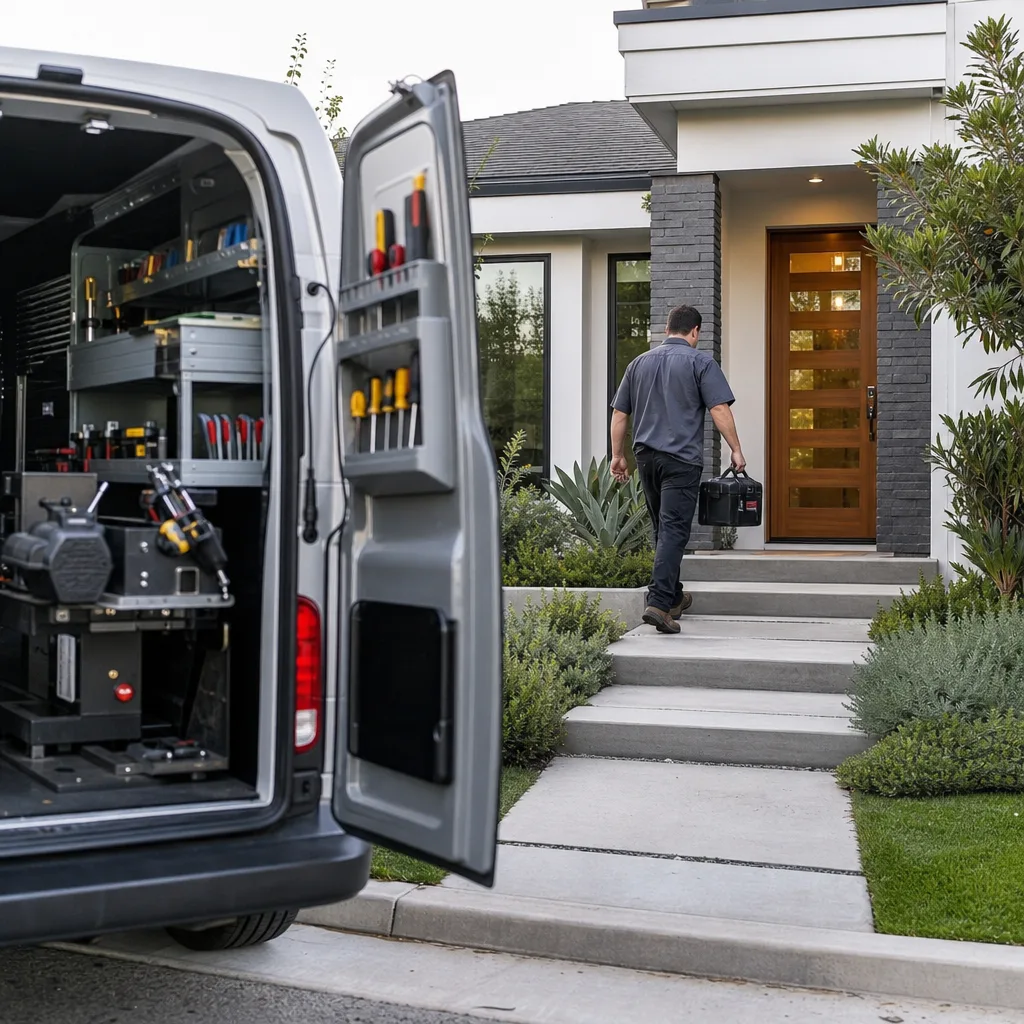
After documenting scams for two decades, we can describe the positive standard with specificity. A legitimate Los Angeles locksmith operation has these characteristics, which align with our Commercial Locksmith Maintenance Checklist for Los Angeles Homeowners:
- A verifiable physical address in the Los Angeles area, visible on Street View with appropriate signage
- A live person answering calls 24/7, not an automated queue or national call center
- Firm pricing quoted before dispatch, with the total price named, not just a “service call fee”
- A marked vehicle with permanent signage, arriving at the time promised
- A uniformed technician whose name you were given, with photo identification
- A written invoice presented before work begins, itemizing all charges
- No price change at the door without a new written authorization
- A documented photo record of the completed work, provided to the customer
- Background-checked technicians, verifiable on request
- Written warranty or promise, with specific terms and duration
At Novak Lock & Security Los Angeles, these aren’t marketing claims. They’re Haven Standard procedures, documented and audited. Clause 1 is the price rule. The photo record is standard on every visit. The 365-Day Done Right Promise applies to every lock installation, rekey, and emergency call. We’ve operated this way since 2002 because the alternative - the bait-and-switch, the upsell, the name discrepancy - is why this guide became necessary.
We handle the full security spectrum, from entry-grade Kwikset and Schlage to high-security Medeco and Mul-T-Lock cylinders, and all pricing is delivered in writing before any work begins. For commercial properties, our Commercial Locksmith in Los Angeles team applies the same standards to master key systems, panic hardware, and access control. For Residential Locksmith in Los Angeles services, we specialize in rekeying, lock installation, and security assessments for homes from Venice to Eagle Rock. Our Access Control Systems in Los Angeles division extends these standards to electronic entry, keycard systems, and integrated building security.
Common Mistakes to Avoid
- Searching only for “locksmith near me” in an emergency. This returns the highest-bidding advertisers, not the most legitimate operators. Search instead for a specific company name, or verify the address and reviews of any result before calling.
- Accepting a “service call fee” quote without demanding the total price. The $19 or $29 figure is designed to anchor your expectations low. Ask explicitly: “What is the total cost to unlock my door, including all labor and parts?”
- Letting a technician start work without a written invoice. Once work begins, your leverage diminishes. The written invoice is your protection; insist on it before any tool touches your lock.
- Paying cash for emergency services. Cash removes your chargeback option and makes documentation harder. Use a credit card for all locksmith transactions in Los Angeles.
- Assuming a local area code means a local business. Voice-over-IP technology allows any operation to acquire any area code. Verify the physical address independently.
- Not verifying the CSLB license in real time. A scam operation counts on you not checking. The 60 seconds at cslb.ca.gov can save you hundreds of dollars and significant stress.
- Allowing mid-job scope changes without stopping and re-authorizing. Any “discovery” can be legitimate, but it requires your informed consent, in writing, with a new price. Never let a technician proceed on verbal assurance alone.
When to Call a Professional
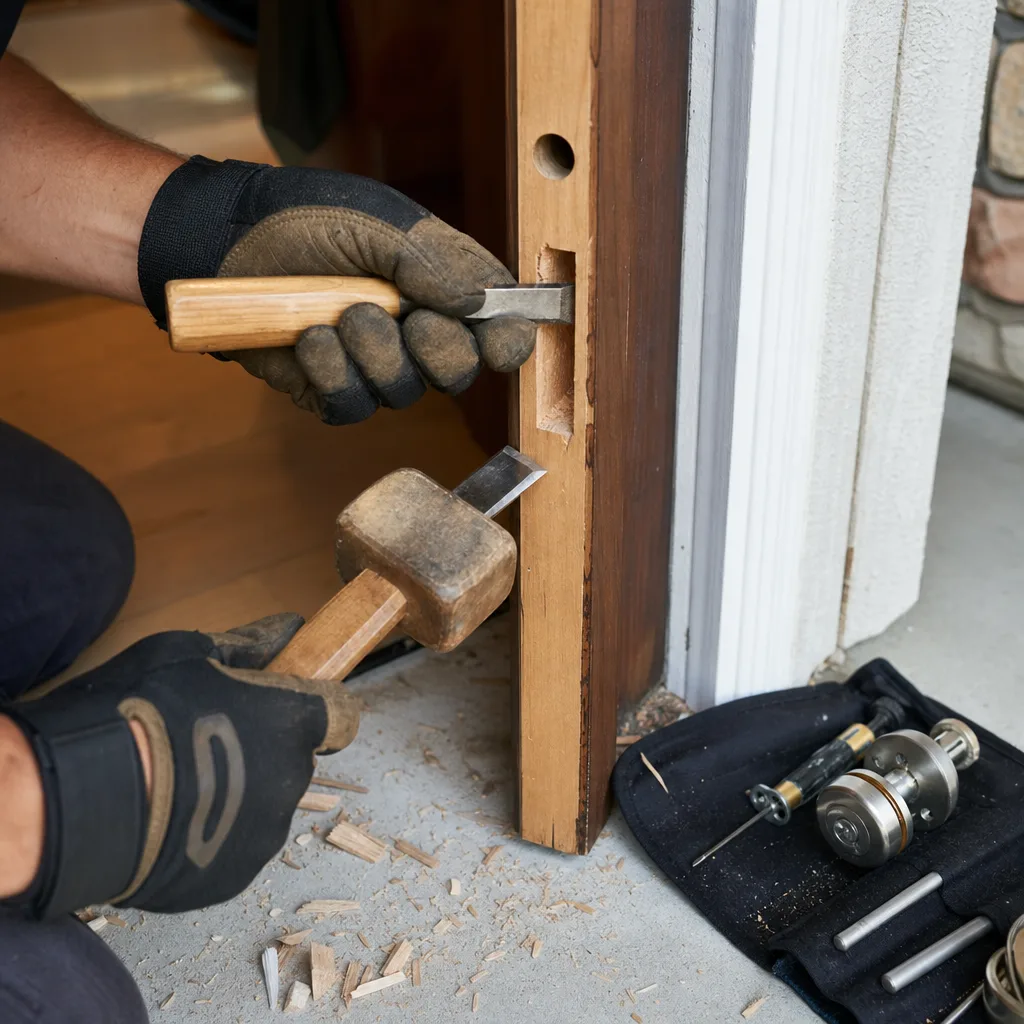
Call a locksmith when you’re locked out, when you’ve lost keys and need rekeying for security, when moving into a new Los Angeles home, when locks are malfunctioning, or when upgrading security after a break-in or neighborhood incident. Don’t attempt to drill, pick, or force a lock yourself - modern residential hardware is designed to resist amateur entry, and you’ll likely damage the door or lock mechanism, converting a $100 service call into a $400 repair.
Novak Lock & Security Los Angeles offers free estimates throughout Los Angeles. Call (213) 632-4875 to speak with a live dispatcher, get a firm written price before any technician is dispatched, and have a background-checked, uniformed technician arrive in a marked vehicle at the time promised. We also provide free second opinions on any written estimate from another locksmith - bring us their quote and we’ll review it at no charge.
Frequently Asked Questions
A standard residential lockout in Los Angeles typically runs $85-$150, a rekey $25-$45 per cylinder plus trip charge, and a deadbolt installation $75-$125 for labor. High-security work with brands like Medeco or Mul-T-Lock runs higher due to specialized hardware. Call (213) 632-4875 for an exact quote - estimates are free, and the price we name is the price on the invoice.
At Novak Lock & Security Los Angeles, yes. Haven Standard Clause 1 prohibits any price change at the door without a new written authorization signed by the customer. The price quoted before dispatch is the price on the invoice. This rule has been in place since 2002.
Ask for the CSLB license number and verify it at cslb.ca.gov. Check that the status is “Active,” the classification covers locksmith work, and the business name matches. Any hesitation or deflection when you ask is a significant warning sign.
Stop the transaction. Do not sign anything under pressure. If you’ve already paid, document everything and file a credit card chargeback within 60 days. File a CSLB complaint if the operator is licensed, or report unlicensed activity if not. In Los Angeles, you can also contact the County Department of Consumer and Business Affairs for referral.
Trust reviews that mention specific neighborhoods, specific hardware brands, and specific outcomes. Be skeptical of generic praise, clustered posting dates, and listings with high review volume but no photo evidence of actual work. Cross-reference with the business’s physical address verification.
Rekeying is usually sufficient and costs significantly less than full replacement. A rekey changes the internal pin configuration so old keys no longer work, while keeping your existing hardware. Full replacement is only necessary if the lock is damaged, outdated, or you’re upgrading security grade. We assess and recommend based on what we find, not what we want to sell.
The Bottom Line
Locksmith scams in Los Angeles follow a documented pattern: fake local listings, vague phone quotes, unmarked vehicles, and mid-job price inflation. The defense is equally systematic - verify the address, demand a total price before dispatch, confirm the technician’s identity, insist on written authorization before work begins, and pay by credit card. These steps take minutes and save hundreds of dollars. The predatory operations count on urgency and trust; your preparation removes both advantages. A legitimate locksmith has nothing to hide, names the price upfront, and documents everything in writing. That’s the standard we established in 2002, and it’s the standard every Los Angeles homeowner should demand.
Written by Daniel Novak, Owner at Novak Lock & Security Los Angeles, serving Los Angeles since 2002.